Collaborative Work
Probes, as defined by Bill Gaver, are collections of evocative tasks meant to elicit inspirational responses. Probes also embrace a notion that knowledge has limits, and that uncertainty, play, exploration and subjective interpretation help us deal with those limits. As we’ve seen from our research to date, the trend of urbanization and the urban structure itself have inherent qualities as well as flaws. As cities become more ubiquitous, questions arise around what defines them, the contributions they may make, the struggles they face, and how they might evolve in the future.
In order to re-frame these questions, we needed to devise a Probes kit that will help us learn more about the identity and nuances of our context’s change and urbanization. We worked in a groups of 4 to develop our kit, and using Bill Gaver's essay to inform our decisions.
Our Tasks:
1. Make a list of the elements that we found most interesting, perplexing, or challenging about our context.
2. Use this list to help form our probes kit tasks. The kit should include at least 3 tasks that explore personal, subjective questions around urbanization and the associated conditions. Shape tasks to give you inspiration-lead, open-ended results – not just to confirm what you already believe.
3. Make multiple kits (6 minimum).
4. Develop a plan for distributing the kits to individuals or groups who may have some insight into our selected context.
Topic:
We chose to explore neighborhoods in New York, more specifically how urbanization has played a significant role in shaping individual perceptions about that area in particular (based on race, economic status and gender)
Kit Instructions:
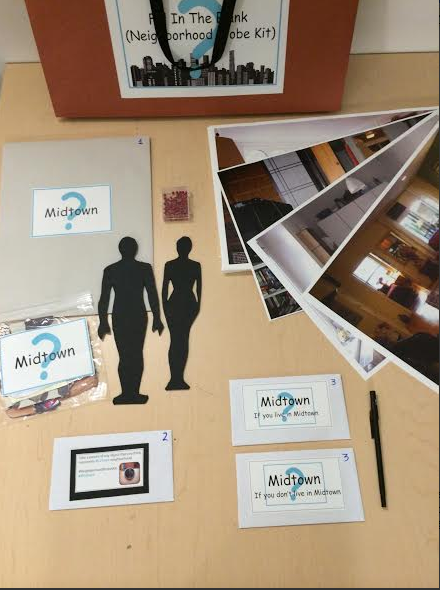
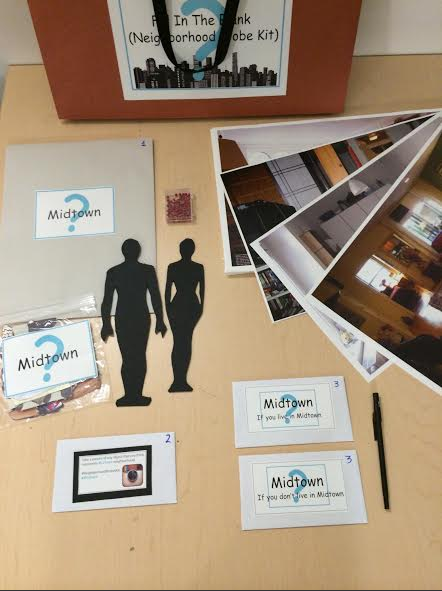
Chose each folder based on whether or not you live in the neighborhood assigned
1. Fill in the blank:
- 2 paper dolls: Give them an outfit according to your assigned neighborhood
- Give each person a face
- Give your person a place to live based on the images of the rooms provided
- Once you have everything together, stick each person onto his or her room and post the individual on the foam board provided
2. Instagram:
Take a picture of any object that you think represents the neighborhood you were assigned. Hashtag the image-#NeighborhoodProbesKit and the neighborhood you were assigned for example #Williamsburg
3. Description: Write 5 adjectives to describe how you feel when you think about the neighborhood you were assigned
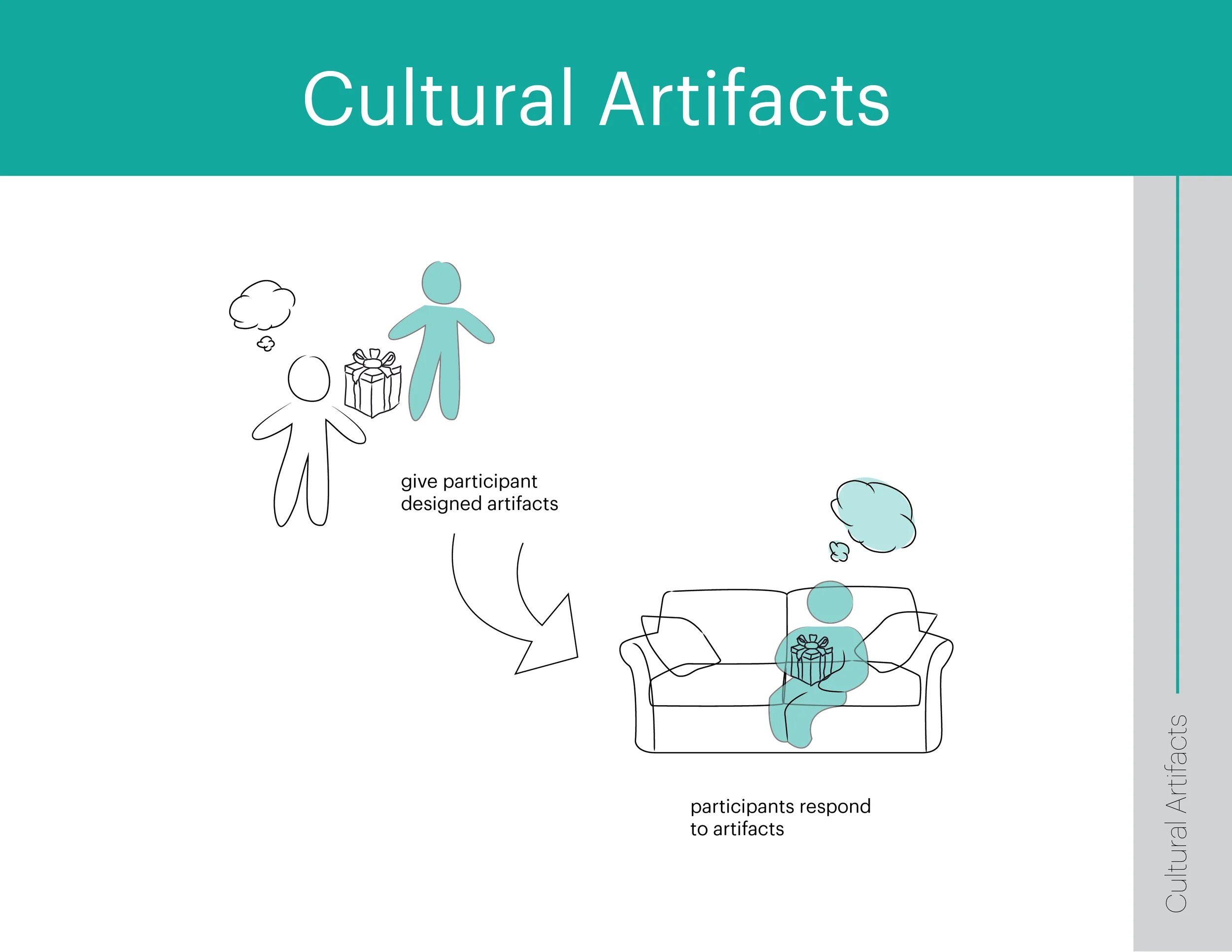
In order to delve deeper into individual perceptions on race, gender and socioeconomic status in New York’s ever evolving neighborhoods, we knew that traditional surveys and questionnaires would merely produce responses that were guarded and would only scratch the surface. Allowing participants to interact with the paper dolls, we were able to provoke dialogue with minimal interference. For instance, in the Stuyvesant Town kit the participant put a picture of a woman’s head on the male’s body and the man’s head on the female’s body. Conceivably these findings could be used by a Market Researcher or a Community Developer to aid in addressing a variety of urban planning issues through the utilization of community, real-estate, and economic analyses. Hypothetically this research could be used to validate the need for a LGBT Community Center in this area.